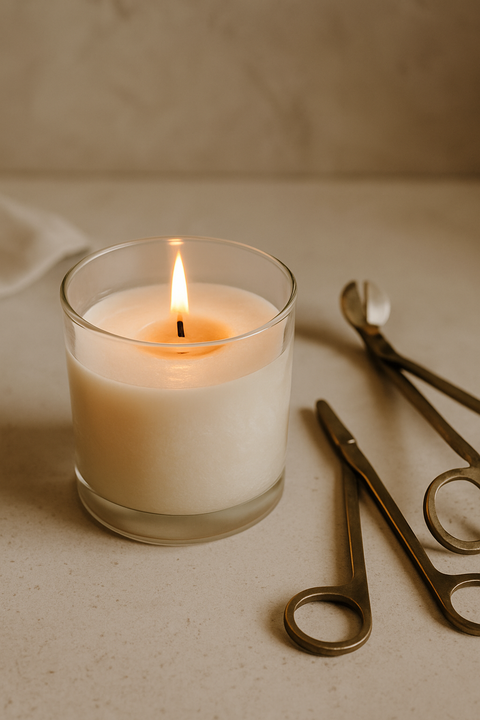
There's an almost magical scene we all seek when lighting a candle: the wax melts into a perfectly smooth surface, the flame dances serenely, and the aroma subtly begins to envelop the space. However, often the experience is cut short by a frustrating phenomenon: tunneling. This kind of pit forms in the center of the candle while its edges remain intact, rendering much of the wax unusable and shortening the product's lifespan. Preventing tunneling in candles is not only possible but also relatively simple when we understand an essential truth: the wick is everything.
What is "tunneling" and why does it occur?
Tunneling in candles occurs when the flame doesn't generate enough heat to melt the wax uniformly across the entire surface. Instead of a homogeneous wax pool, combustion is limited to a small central area, leaving a solid ring of wax that prevents the wick from utilizing the remaining material. The result is not only aesthetically unpleasing but also a waste of wax and fragrance. And, like everything in candle making, the solution begins with choosing the right wick.
Choosing the right wick: science and sensitivity
Each wick has a recommended burn diameter, meaning the width of the surface its flame can efficiently melt. Wick manufacturers usually indicate this value as a reference. For example, if you're pouring your candle into an 8 cm diameter container, it's logical to start by testing a wick that has the capacity to melt precisely that surface.
What if the flame produces too much black smoke? That's a clear sign that the wick is too thick. What if, on the contrary, the candle starts to tunnel? Then, it's very likely that the wick is too thin for the container or the wax composition.
This is one of the reasons why crafting high-quality artisanal candles requires not only technical knowledge but also sensitivity and experience. Each candle is a delicate balance between fire, wax, fragrance, and color.
Fragrances and colorants: allies of ambiance, enemies of combustion
Fragrances and colorants are essential for bringing sensory life to a candle, but they also pose a technical challenge. Aromatic oils tend to interfere with combustion, making it difficult for the flame to maintain a high temperature. The same applies to pigments, especially dark or intense ones, which can alter the wax's consistency.
In these cases, a slightly thicker wick than recommended for the container's diameter may be necessary to compensate for this effect. The key is to find the sweet spot: not so much that the flame is aggressive, nor so little that it drowns out.
The first burn ritual: essential
Even if the candle design and material choices are correct, everything can go wrong if one of the most important moments in a candle's lifecycle is not respected: the first burn. When a candle is lit for the first time, it must be allowed to burn long enough for the entire surface to melt. This usually takes between one and two hours, depending on the candle's size.
Extinguishing it before a complete wax pool forms is, literally, inviting tunneling to set in. Wax has memory, and once it has melted only in a central area, the candle will tend to repeat that burn pattern every time it's re-lit. Therefore, the first burn is a ritual that deserves attention, calm... and perhaps a cup of tea or a good book.
Aesthetics also matter
Beyond the technical aspect, choosing the right wick is also a matter of aesthetics. A flame that is too tall or unstable can ruin the atmosphere we seek to create. And a candle that burns elegantly, without smoke or residue, is not only more enjoyable: it also speaks of care, design, and respect for the materials. A well-made candle is an object of contemplation, not just function.
Learning with your hands: workshops for candle lovers
For those who wish to go beyond lighting candles and enter the art of creating them, Vento Barcelona's workshops are a gateway to that universe. In the Artisanal Scented Candle Workshop, participants not only learn to combine waxes and fragrances but also to choose the correct wick according to the jar's diameter, the fragrance load, and the proportion of pigments. This technical knowledge, taught in small groups by expert artisans, is essential to avoid common mistakes like tunneling.
With a rigorous yet accessible approach, these workshops offer a complete sensory experience: from selecting premium ingredients to creating a unique object that will carry your personal touch. Moreover, they provide an inside understanding of the secrets that make a candle not only illuminate but transform the environment.
Because when a candle is well-made, the flame doesn't just burn: it breathes. And in that breath, there is art, balance, and a spark of magic that turns the everyday into something special.