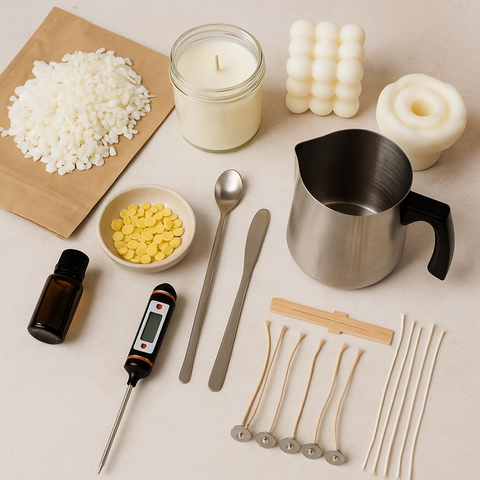
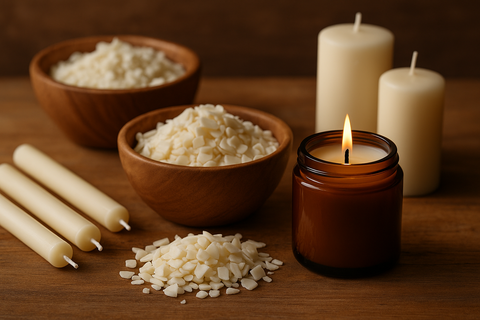
In the world of artisan candle making, where every detail counts, the soul of each creation lies in the choice of materials. And when we talk about scented candles, wax is the essence that envelops everything: it is the base that contains the aroma, that melts slowly to release sensations, that defines the texture, color, and experience. Among all options, soy wax has established itself as the preferred alternative due to its vegetable origin, clean burning, and sustainable image. But behind this apparent purity lies an important nuance that many ignore: not all soy wax is the same, and assuming it is can ruin even the most beautiful candles.
Soy Wax and its Deceptive Simplicity
Most specialized stores or online marketplaces label their products in a simplified way: “soy wax for scented candles,” or at most, “low melting point soy wax.” However, this generic denomination conceals a much more complex reality. In the industrial process, soy wax is obtained from hydrogenated soybean oil, and the degree of hydrogenation (i.e., the transformation of liquid oil into a solid wax) directly affects the melting point, texture, and stability of the wax.
Professional manufacturers don't just sell "soy wax." They sell soy wax 46, 48, 50, 52, up to 56, according to that melting point, which is usually indicated precisely. For example, a "Soy 48" wax has a melting point that ranges between 47 and 49 °C. This technical information is crucial for candle production because it influences how the wax will behave when melting, how it will capture the aroma, and how it will release it when the candle is lit. A candle with inadequate wax may not release enough fragrance, deform in warm climates, or generate unwanted "frosting."
The Problem with Broad Ranges
When an online store advertises soy wax with a melting range like “50–55 °C” without indicating a specific type, it is likely a blend of different waxes. These blends allow for cost reduction or supplier flexibility, but for the candle maker, they represent a risk.
The big problem with these blends is the lack of consistency. If one batch of candles is made with a blend containing a higher proportion of soy wax 50, and the next batch with a greater presence of wax 54, the results will vary. The aroma may behave differently, the burn time will be affected, and, most frustratingly, the visual appearance could change for no apparent reason.
In practice, this means that repeating a winning formula becomes almost impossible. And when you work with delicate aromas, precise mixtures, and careful design, every small detail counts.
Why does this matter?
Because as a craftsman, designer, or simply a candle lover, you are looking for more than a dim light. You are looking for consistency, quality, beauty. And that starts with the wax.
A wax with a stable and defined melting point is a fundamental pillar for working with precision. It's not just about the final aesthetic, but about ensuring that the candle you so carefully crafted — from the choice of jar to the floral or spicy aroma — burns evenly, that its fragrance fills the room harmoniously, and that it doesn't disappoint whoever lights it.
Furthermore, many people have experienced frustration when making their own homemade candles with seemingly “natural” waxes that, without explanation, sink in the center, tunnel, or barely emit any scent. The cause, in many cases, is a poor choice (or bad advice) regarding the type of soy wax used.
Choosing Well from the Start
The advice, therefore, is clear: if you buy soy wax to make candles, demand to know what type you are acquiring. Is it Soy 46? Soy 50? Does it have an exact melting point or is it a blend? A serious supplier will give you that information directly. And if not, perhaps you should look for another.
Candles are ephemeral small sculptures that accompany important moments. They do not deserve to be betrayed by mediocre materials or ambiguous information. Making better candles starts by thoroughly understanding the materials we work with.
The Art of Conscious Creation
At Vento Barcelona, wax is more than an ingredient: it is a living material that we engage with. In our aromatic candle making workshops, we explore the selection of waxes according to their behavior, texture, and fusion with aromas. We teach how to balance fragrances, how to choose the right wick according to the diameter, and how to optimize combustion so that each candle is not only beautiful but also functional.
If you are interested in delving deeper into the art of wax, feeling its behavior in your hands, and learning to control all the factors that influence a quality candle, we invite you to discover our Artisan Aromatic Candle Workshop. In it, you will discover how the combination of technique, sensitivity, and knowledge transforms a simple jar of wax into an unforgettable sensory experience.
Candles teach us that even the ephemeral can be eternal if made with love and precision. And it all starts with knowing what your light is made of.