
Lighting a candle is an intimate gesture. It is invoking warmth, perfuming the air with subtle memories, and enveloping the space in an atmosphere that caresses the senses. But even the most delicate pleasures require attentive care. To ensure your soy wax candle retains its beauty, aroma, and integrity over time, we've put together a comprehensive guide that balances the art of the everyday with the elegance of ritual.
1. Conscious lighting: choosing the right place
Even before lighting the wick, there is a moment of contemplation. That prior, almost silent instant, when we choose the right place for our candle is, in itself, an act of intention. Because a candle, more than an object, is a small universe of light, aroma, and meaning. Choosing its location is like setting the stage for a ritual: intimate, careful, full of intent.
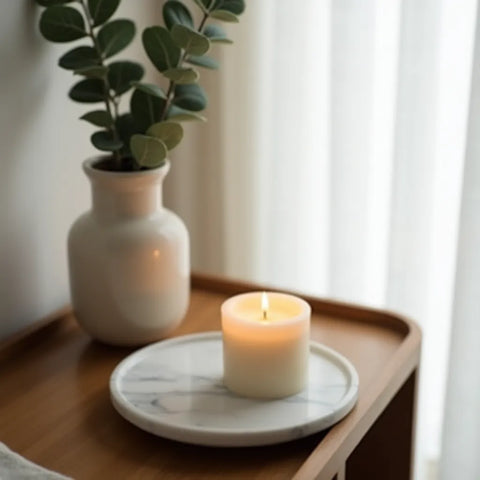
Look for a flat, firm, heat-resistant surface, preferably made of stone, ceramic, or treated wood. These natural textures not only guarantee safety but also visually harmonize with the timeless and serene aesthetic that soy wax candles evoke. A stable base ensures that the wax melts evenly, without tilting or warping that could affect how it burns.
Avoid placing the candle near drafts, such as open windows, ventilation ducts, or fans. Although imperceptible, these breezes can cause the flame to flicker unstably, leading to uneven burning, excessive smoke, or even soot buildup on the wick. Furthermore, air movement can interfere with the diffusion of the aroma, dispersing it before it can imbue the space with the desired subtlety.
Keep the candle away from flammable or easily combustible materials. This includes wispy curtains that move with the wind, decorative papers, books, dry plant fibers, or even ornamental plants which, while aesthetically charming, can pose a risk if too close to the flame. Pay special attention to hanging or suspended objects that may be located directly above the jar, even if they don't seem to be in direct contact with it.
In spaces shared with children or pets, extreme caution is essential. Natural curiosity, both childish and animal, finds fascination in the flickering of a flame or the soft aroma of a lit candle. Therefore, it is ideal to place it out of their reach, on elevated shelves, decorative trays, or small side tables where they can be admired without risk.
The ideal environment for your candle should also be a reflection of your style. You can accompany it with objects that evoke calm: a polished stone, a dry olive branch, an art book open to an inspiring page. The candle thus becomes the silent center of the space, an invitation to slow down, breathe deeper, and reconnect.
Always remember: fire, though contained, is still fire. Tamed, it can become the warm heart of a room; neglected, it can become a problem. Safety is not at odds with beauty. On the contrary, it is part of that invisible elegance that resides in well-thought-out things.
In short, lighting a candle is much more than lighting a wick. It is creating atmosphere, cultivating presence, and shaping a moment. And that moment always begins by choosing the right place.
2. The first lighting: the memory of the wax
Every candle has a story that begins with its first breath of fire. And that first lighting is no ordinary gesture: it is the moment when the wax, wick, and container synchronize for the first time, marking the beginning of a bond between the candle and the space it inhabits.
This first use establishes what candlemakers call the “wax memory”. Although it may seem like a technical detail, it is an essential principle for preserving the beauty, performance, and harmony of your soy wax candle. Ideally, it should be left burning for a minimum of two hours, or at least until the entire top surface has melted evenly, reaching the inner edges of the jar.
Why is this first bath of light so important? Because if the candle is extinguished too soon, when only a small circle in the center has melted, the wax will "remember" that shape and tend to repeat it in subsequent uses. This is how the dreaded tunneling effect appears, a deep depression in the center of the candle that leaves layers of solid wax stuck to the container walls, wasting product and ruining the perfect aesthetic of the jar.
Instead, if given time, soy wax—soft, vegetable, and naturally creamy—learns to melt gracefully, forming a liquid pool that extends to the perimeter. This uniform process allows the candle to burn consistently in subsequent uses, without residue, without imbalances, and releasing its aroma with the subtlety and depth it was designed to offer.
Think of this first lighting as a baptism of fire. It is the instant when the candle awakens and adapts to the outside world; when it prepares to accompany you in moments of reflection, inspiration, or simply everyday pleasure. It is a small act of patience that has lasting rewards.
To enhance this experience, we suggest creating a serene, uninterrupted environment. Perhaps a cup of white tea, a soft melody, a dim light… and letting time flow with the flame. Letting it burn unhurriedly is also a gesture towards yourself: a way of remembering that beautiful things require presence.
In short, the first lighting is not just a technical matter: it is an inaugural ritual, a promise of balance and longevity. It is the most delicate and conscious way to bring to life that light which, from now on, will be part of your home.
3. Extinguishing with elegance: caring for the wick and the aroma
The end of a burning candle should be as beautiful and thoughtful as its beginning. Extinguishing the flame is not merely a functional gesture, but an intimate act, charged with intention. The way you choose to close that moment speaks volumes about the care you put into things, your relationship with the objects that inhabit your space, and your sensitivity to the details that make a difference.
Blowing it out, even if it's the classic image of a romantic gesture, is not always the kindest option. The abrupt air weakens the wick, can cause hot wax to splash, and most importantly, leaves behind a trail of dense smoke that dulls the atmosphere and distorts the residual aroma that would otherwise remain subtle and pleasant in the air.
The olfactory experience of a candle doesn't end when the flame goes out. The fragrance continues to linger for a few more minutes, and it deserves to do so without interruptions or smoky notes. That's why we invite you to extinguish your candle with the same delicacy with which you light it: unhurriedly, without harshness, without violence.
The ideal option is to use a candle snuffer—a simple and beautiful tool, reminiscent of ancient domestic rituals where light was controlled with grace and precision. Its conical shape covers the flame without crushing it, gently depriving it of oxygen, without disturbing the wick or the wax.
But if you wish to go a step further in the art of care, you can opt for an even more refined gesture: dipping the wick into its own liquid wax. This method, though little known, is profoundly effective and elegant. With the help of a small tool—it can be a steel stick, a ceramic rod, or even stylized tweezers—gently tilt the wick until it touches the melted wax, allowing the wax itself to extinguish the flame. Then, just as gently, lift it back up and straighten it.
This small gesture has multiple benefits: it prevents smoke, coats the wick with a thin protective film, and prepares it for the next lighting, preventing it from unraveling or burning unevenly. Additionally, the wax acts as an aroma preservative, sealing that last instant of fragrance with a perceived purity.
Make this moment your own. Close your eyes. Observe how the flame quietly yields, without harshness. Perceive the faint aroma still lingering, like a sweet and sophisticated farewell. And if you wish, accompany the gesture with a deep breath: extinguishing a candle can also be a way to close a thought, a memory, a small end-of-day ritual.
In the universe of candles, where every detail counts, how you extinguish matters as much as how you light them. And doing so with elegance is another way of living with intention, beauty, and harmony.
4. The wick: a ritual trim before each lighting
There is something profoundly poetic in preparing a candle before lighting it. It is a gesture that seems minimal, almost insignificant, yet it holds an ancient wisdom: prior care is what allows for lasting beauty.
One of the best-kept secrets to prolonging the life and elegance of your candle is to lovingly attend to its wick. Before each use, take a few moments to observe it with calm attention. Is it too long? Carbonized at the tip? Twisted or weak? These small signs tell us about the condition of the candle, how it has burned before, and how it will burn this time.
The ideal wick length—between 0.5 and 0.75 centimeters—is key to achieving harmonious combustion, a serene flame, and an undisturbed olfactory experience. If the wick is too long, the flame will grow excessively, stir the air, and can generate smoke, soot, or small sparks, in addition to consuming the wax more quickly. On the contrary, a short, well-maintained wick burns with a firm, clear flame, and gives life to that gentle sway of light that is so calming.
For this small ritual, you can use a wick trimmer—a refined tool, precisely designed to cut at the right angle without damaging the integrity of the wick—or clean scissors, as long as they are sharp and free of residue. When cutting, also make sure to remove any detached fragments so they don't fall onto the wax surface: these small particles can cloud the liquid wax or even interfere with combustion, generating a slight burnt smell that breaks the charm of the aroma.
This gesture, though brief, has something of a silent meditation. It is a moment to pause, to respectfully observe an object that is about to transform into light. The simple act of bending over the candle, breathing, calmly cutting, is almost a ceremonial act. A reminder that the sacred can also inhabit the everyday.
Do not underestimate the power of small rituals. Preparing the wick before lighting the candle is a way to honor the object, but also to honor the moment you are about to create: an afternoon of reading, a relaxing bath, an intimate after-dinner conversation, or a moment with yourself.
And in the end, what is a candle but a symbol of presence? Caring for its wick is caring for that symbol. Allowing the light to emerge with balance, the wax to melt with harmony, the aroma to be released with softness. And for it all to begin with a precise, delicate… almost poetic cut.
5. Time and rhythm: no more than four hours
In the universe of candles, as in life, rhythm is everything. Lighting a candle is inviting calm, but it is also listening to its natural cadence, respecting its limits, and letting it breathe between each act of light. Because even a candle—an apparently silent object—speaks to us. And it does so through time.
Never leave it burning for more than four consecutive hours. This is not just a safety recommendation, but a subtle way to preserve the integrity of the object, its beauty, and its ability to give pleasure again and again. Soy wax, due to its vegetable origin, is noble, delicate, almost alive. Its soft, creamy texture allows it to burn cleanly and evenly, but also makes it vulnerable to excessive heat.
When a candle remains lit for too many hours, its wax can overheat and become unstable. This can lead to excessively rapid combustion, deterioration of the aroma, displacement of the wick, or even uneven melting of the wax, affecting the balance of the container. Sometimes, this excess manifests as a slight change in color or an irregular edge that wasn't there before.
Giving it a break is honoring its natural cycle. Let it rest. Wait for the wax to cool completely and solidify before lighting it again. Observe that change of state: from golden liquid to a smooth, satiny, almost marbled surface. There is beauty also in that transition. In its stillness.
You can think of each use as part of a complete cycle: lighting, enjoyment, rest. The candle also needs its moment of silence to recompose itself. Just as we care for our energy, our breath, the rhythm of day and night… caring for the rhythm of a candle is almost a metaphor for self-care.
A good practice is to reserve those four moments of light—those four hours—for special situations. A long lunch with friends, a rainy afternoon with reading, an intimate dinner that stretches on without checking the clock. And then, let the candle sleep. Let it become a promise again. Let it be preserved, so that when you light it again, it gives you the best of itself.
A well-cared-for candle not only lasts longer, but burns better. Its flame will be more serene, its aroma purer, its shape more elegant. And it all begins by learning to respect its rhythm.
6. Keep it away from heat: protecting the nobility of soy wax
Within every soy wax candle lies an essential delicacy. It is not just any wax: it is vegetable, natural, soft to the touch, and has a milky appearance reminiscent of porcelain. Its sustainable origin and its ability to gently release fragrances make it a preferred choice in contemporary wellness and design rituals. But like all noble matter, it requires subtle and attentive care.
Soy wax is especially sensitive to high temperatures and direct light. Its melting point is low—much lower than synthetic or paraffin waxes—which allows it to melt slowly and evenly when lit, but also means it can be easily altered if exposed to external heat for prolonged periods.
Avoid placing your candle near radiators, stoves, fireplaces, hot appliances, or any source of intense heat, even when it is unlit. And above all, protect it from direct sunlight. Sometimes, a candle placed next to a sunny window—though visually charming—can begin to show signs of thermal stress: small drops on its surface ("sweating"), changes in texture, or even a slight separation between the wax and the jar. In extreme cases, the container may deform, crack, or become unstable, especially if it is not made of tempered glass.
These types of alterations not only affect aesthetics but also aromatic performance and combustion stability. The wax can lose its ideal structure, and the essential oils—so carefully balanced—can evaporate or degrade prematurely, losing depth and complexity.
Therefore, we recommend storing your candle as you would a designer perfume: in a cool, dry, and shaded place, away from thermal fluctuations and humidity. A linen closet, a protected shelf, or a small wooden box can be perfect sanctuaries. Even unlit, a candle remains a sensitive object, absorbing the conditions of the space that surrounds it.
Furthermore, preserving it well is a way to extend its lifespan and to maintain its olfactory essence intact until the last lighting. Because, after all, a candle is also a form of perfume, not just for the air, but for the soul. And like all perfume, it deserves to be treated with care, with reverence, and with a touch of domestic art.
Thus, each time you light it, you will know that you are not only illuminating a room, but also giving continuity to an object that has been respected, protected, and valued in all its beauty.
In summary: the art of caring for what cares for us
Caring for a candle is more than following a series of technical steps. It is cultivating a gesture of respect towards the objects that beautify our lives. It is understanding that, at the heart of design, also beats the delicacy of conscious use.
Soy wax candles are not just a decorative element: they are a subtle presence that accompanies our most intimate moments. A soft light for thoughts, an aroma for memory, a flame that reminds us of the beauty of the ephemeral.
Make every lighting a ritual, and every ritual, an experience.