The art of making homemade candles can be as rewarding as it is challenging. Often, those who venture into melting, pouring, and scenting their own creations find that, after hours of excitement and effort, the final result is not what they expected. Deep tunneling, excessive soot, cracks, frosting, or unwanted streaks can frustrate even the most enthusiastic candlemaker. However, every mistake presents an opportunity for learning and improvement. In this article, we address the most common problems in candle making and how to turn them into lessons to achieve artisanal quality pieces.
The dreaded tunnel: when the candle only burns in the center
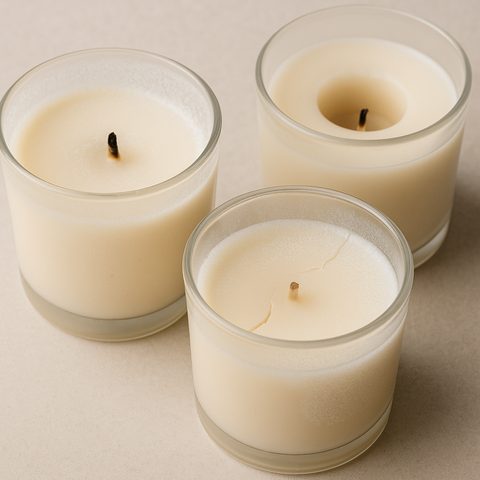
One of the most frequent —and visually disappointing— errors is candle tunneling: that narrow cavity that forms when the wax only melts in the center, leaving the side walls intact. This phenomenon usually originates from an incorrect wick, either too thin for the candle's diameter or poorly positioned.
The solution involves understanding that there is no single universal wick. Each combination of wax, fragrance, dye, container shape, and diameter requires a testing process with different wick types and sizes. The ideal approach is to test the candle under real conditions (at least three consecutive burns lasting several hours) and observe how the burn progresses. A suitable wick will melt the wax to the edge of the jar without creating an excessive flame or soot.
Cracks and frosting: cooling matters more than you think
Surface cracks or the "white frost" effect (known as frosting) are particularly common problems when working with vegetable waxes like soy. Although they do not affect functionality, they do compromise the candle's aesthetics, detracting from the smooth, polished finish we associate with quality pieces.
Both defects are related to pouring and cooling temperatures. Pouring wax that is too hot can cause internal bubbles, while abrupt cooling (for example, in cold environments or on stone surfaces) facilitates the appearance of cracks and frosting. The secret is to pour the wax between 55 ºC and 65 ºC (depending on the type) and allow it to cool slowly in a temperate environment, away from drafts. Covering the container with a towel can help maintain a constant temperature during cooling.
Soot and uncontrolled flame: a matter of safety
A candle that produces black soot or whose flame crackles and becomes uncontrolled is not only an aesthetic problem but also a risk. In the worst-case scenario, an excessively thick wick can overheat the jar, causing cracks or even breakage.
Here again, the heart of the problem is usually incorrect wick selection. The material (cotton, wood, braided, waxed), its thickness, and even its rigidity directly influence how the candle will burn. A stable flame, without smoke or residue, is a sign that you have chosen well. Don't be afraid to invest time in experimenting and adjusting. Every candle must pass its "baptism of fire," literally.
Wax that doesn't adhere to the jar
Nothing is more disappointing than seeing the wax detach from the container walls, forming air pockets or opaque spots. This problem is especially visible in candles in glass jars and can devalue a piece that is otherwise well-crafted.
To avoid this, it is crucial to choose the right wax. Some vegetable waxes adhere better to glass than others. Additionally, the container must be perfectly clean, dry, and at room temperature when pouring. If it is too cold, the wax will solidify prematurely, creating that separation effect. Slightly preheating the jar can make a big difference.
The art of testing and perfecting
Perhaps the greatest lesson that homemade candle making teaches us is the importance of small details. Every variable —the wax, the wick, the scent, the pigment, the container, the temperature— has a real and measurable impact on the result. Therefore, we recommend keeping a testing notebook where you record your combinations, temperatures, and times. Systematic record-keeping allows you to learn from every mistake and successfully replicate your best creations.
And if you feel like you need guidance, you're not alone. Vento Barcelona offers specialized workshops where you will not only learn how to avoid these errors but also how to develop an aesthetic and technical criterion that will transform your creative experience. In our Artisan Aromatic Candle Workshop, you will discover how to choose and test wicks according to the type of wax and container, master the pouring temperature, and create compositions that not only decorate but also convey sensations.
Because every candle is a story. And every mistake, a page of learning that brings us closer to the beauty of handmade.