In the world of decorative candles and aromatic candles, innovation continues to advance towards new olfactory and visual experiences that transform any space. Wax blends are an excellent example of this evolution, offering possibilities for personalization and versatility that elevate candles to an art form. However, working with different types of wax in combination brings both notable advantages and unique challenges, making the creation of these candles a practice that is as fascinating as it is complex.
Advantages of Wax Blends
Wax blends allow artisans to combine the best of each wax type, creating a luxurious experience in every candle. From improved burn time to a more enveloping fragrance, blends make it possible to refine every detail of the candle to meet the highest expectations.
1. Longer Burn Time and Better Burn Quality
One of the main advantages of blending waxes is optimizing burn time. For example, by combining soy wax and paraffin wax, you get a candle that retains the smoothness and longevity of the former, with the luminous intensity of the latter. Beeswax is another exceptional ally for blends, as its high melting point allows for a longer and more stable burn. This quality is ideal for those looking for a long-lasting, clean-burning candle.
2. Fragrance Intensification
For those who enjoy scented candles, blends offer remarkable fragrance retention capabilities. Coconut wax is highly valued in blends due to its exceptional ability to retain aromas, allowing the fragrance to remain potent and present throughout the candle's lifespan. By combining it with other waxes, a synergy is created that allows the aroma to be distributed evenly without losing intensity, a quality especially appreciated in large spaces or areas where the aroma is intended to be a subtle but constant protagonist.
3. Personalized Aesthetics and Texture
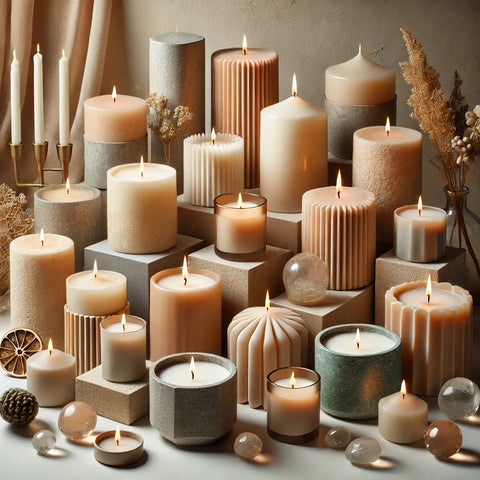
Wax blends offer unique texture and appearance that can range from a sophisticated matte finish to a crystalline and shiny one. Soy wax, for example, provides an opaque hue that gives a soft and natural look, while paraffin offers a more polished and glossy appearance. This allows each candle to be transformed into a carefully crafted design piece, adapting to different decorative styles and becoming a distinguishing detail in any space.
Challenges of Creating Candles with Wax Blends
Although the advantages are considerable, working with wax blends also involves facing certain technical challenges that require precision and deep knowledge of each component. These challenges primarily arise in terms of compatibility, stability, and sustainability.
1. Wax Compatibility
Not all waxes mix easily. Some have different melting points and, when combined, may not integrate well, which affects burn quality and candle stability. For example, soy wax and paraffin wax, though popular in blends, require specific handling to ensure a homogeneous and balanced mixture. It is essential to experiment with different proportions and heating methods to achieve a uniform texture and efficient burn.
2. Considerations in Fragrance Retention
While wax blends can improve aroma retention capacity, they also require special care when dosing fragrances. Certain waxes, such as beeswax, can neutralize or alter certain aromas if not properly combined with other types of wax. This challenge implies mastering both the materials and the intensity and purity of the essences, and forces creators to test different combinations until the optimal blend is achieved.
3. Sustainability and Natural Sources
As interest in sustainability in decoration continues to grow, the use of natural and renewable waxes is increasingly in demand. However, combining natural waxes like soy or coconut can be more costly and requires an exhaustive search for suppliers who guarantee the quality and ethical origin of the materials. Furthermore, it is important that blends do not include synthetic components if a completely sustainable candle is desired, which can make it difficult to achieve certain texture and aroma effects obtained with waxes like paraffin.
Conclusion
Wax blends represent a fascinating field within the creation of high-end candles. They offer the possibility of customizing both the aesthetic and olfactory experience, allowing each creator to bring to life unique candles that reflect their style and that of their customers. However, it is a process that demands dedication, patience, and a deep knowledge of the properties and compatibilities of each wax.
As decorative tastes evolve and sustainability gains increasing importance, blends will continue to solidify their position as a sophisticated and conscious choice, capable of adding a distinctive touch to any space. Candles made with wax blends invite a unique sensory experience, where aesthetics and well-being merge to create memorable moments.